DEPARTMENTS

Showing posts with label Monsters. Show all posts

Monday, January 26, 2026

THE APE CAT - A NEW MOSNTER IDEA FROM A LOCAL LEGEND


The Pacific Northwest is known for some pretty famous cryptis, most notably the Sasquatch or Bigfoot. There are others such as the giant octopi of the Tacoma Narrows, Tree Octopi, even several lake monsters but there is one that I only recently learned about that seems like the right sort of critter to include as one of D&D's weirdo monsters - The Ape Cat

Known as the Klickitat Ape Cat, the creatures is said to be a large, panther-like cat with a six-foot long tail and the face of an ape, with hair that sticks out. It's said to haunt the area around The Columbia River Gorge where it stalks the waters and bluffs. It is said to mess with electrical devices and compasses. 

In old school D&D terms this gives us an interesting monster that seems like it might carry some sort of electric charge. The disruption of electronics is unlikley to be a thing in a fantasy setting, so we can make this into it carrying and active electrical ability and being resistent to or immune to things like lightning and such. We can even extapolate on the purpose of the long tail. Like the illustration below, it may simply be a swimming tool but we can also make it into an attack, with the Ape Cat using it's tail to lash at or even snare enemies and zapping them with its electricity. 

APE CAT (B/X)
No. Encountered: 1 (or maated pair)
Alignment: Neutral
Move: 150' (50'), 100' (30') swimming
Armor Class: 6
Hit Dice: 4+4
No. of Attacks: 2 claws or tail*
Damage/Attack: 1d4/1d4 or *save vs dragon breath or 2d10 damage from shocking tail.
Save: F2
Morale: 10
Treasure Type: U

The ape cat is a magical creature of unknown origin, Some say, like the owlbear, that the creature is the magical melding of two creatures though others believe it to be a relative of the displacer beast, though there is little to substnatiate either. Ape cats prefer rocky areas near bodies of water such as river gorges or alpine lakes. They are not found on oceans coastlines though and seem to prefer inland haunts where they can retreat to the brush and trees when not stalking prey or fishing in the waters. 

These creatures have the ability to generate an electric charge and use their 6ft-long tails as a lash with which to attack and stun prey. In water, they can discharge their electicity around them, stunning small prey but not enough to damage anything larger than fish or small animals. When threatened, the air around the hums and their fur stands on end, showing they are charged and ready to strike. 

Ape cats are solitary except during mating seasons, when they pair up, often with the same makte year to year. Ape cats prefer to make their dens in the sides of the cliffs and bluffs they hunt from, digging shallow holeso r using natural cave where they will raise broods of 2-5 kittens. While ape cats are of only animal intelligence, they can mimic humanoid-sounding noises, often giving the illusion of speach without actually saying anything. 


Monday, December 15, 2025

BUILD YOUR WORLD THROUGH YOUR MONSTERS


Over the decades, D&D and other fantasy games have seen the creation of countless monsters for use in games. While there are many monster that are made with specific worlds or settings in mind, most of these are designed with very broad strokes and generally fill the need for an everflowing wellspring of opponents for DMs to throw at their players. Such a generalized approach to monster design certainly succeeds in keeping players on their toes and indulging GMs in their desire to constantly surprise and vex their players, however, this also leads to many game worlds lacking definition and identity. 

I have often heard that players grow tired of fighting the same monsters over and over again but I often wonder if this is a projection of GMs put upon their players based on perceived or even wholly imagined concerns. Many classic fantasy worlds are carefully curated with monsters and other foes becoming integral parts of those settings and providing a ready shorthand for the themes and character of those worlds. Tolkien's world is distinct from C.S. Lewis' and much of this has to do with the monsters that populate them. While Tolkien's world has some familiar denizens such as dragons and giants, many of them are very much unique or at least different rom others. Lewis, instead, chooses to populate his world almost exclusively and quite purposefully with classic creatures of myth and legend (including Santa Claus) and this makes both these classic fantasy realms feel distinct from one another even though they are both recognizeable as defined fantasy worlds. 

It would be easy to argue that these worlds are the products of authors crafting stories and that they are thus very different from gaming worlds. Game worlds are, afterall, made for gaming in and it makes sense that there be a desire, perhaps even a need for a steady supply of new monsters to populate adventures. True as this may be, it is also possible to regulate the flow of new monsters while maintaining a consistent caste of creature that sets the tone and feel of your world. Maintaining a steady but restrained pace when introducing new monsters will go far in establishing the character of your game world and will aid in your storytelling. 

Once you have established the "normal" monsters for your world, you can focus your GMing work on how to use them and build stories including and focused around them. What's more, your players will be able to use this consistency to help engage with the world. When you send your players to a swampy region and it is established, through lore and previous encounters, that swamps are places where lizardmen can be found, the wheels will begin to turn when your players are required to go there. This doesn't mean that you should add in other swamp dwellers or that every visit to the swamps means lizardmen, but it does mean there should be an expectation that such an encounter is very likely.


Setting expectations and maintaining them as a matter of course does not mean creating a boring fantasy world. It means creating a world that lives and breathes and plays by rules and a degree of verisimilitude which you can then use to truly hightlight those things that stand out. If swamps are places where lizardment are found (to use the previous example) and the players start to find swamps devoid of lizardmen, having established the lizardmen's ubiquity should make their absence obvious to your players without you having to specifically highlight that absence. Furthermore, the lizardmen allow you a foundation to build on to the lore of your swamps and they become a vehicle for you to introduce new, but thematic enemies. When the lizardmen go to war with their neighbors, what monsters do they bring with them? Do they ride giant lizards and besiege settlements atop massive war turtles? Are they led to this conflict by a swamp hag who has it in for a local baron who has vexed her? 

The use and resuse of monsters is important to creating a world and while the constant flow of new monsters may be tempting, their inclusions should be done purposefully and with restraint so as not to erode the work you have done in crafting a world that players feel their characters truly live in.


Wednesday, December 3, 2025

20 LEAGUES UNDER MY BELT - REPEAER BONES DEEP ONES


Not exactly a league's worth of minis but they could be if you built them on the tougher side of how Deep Ones are portrayed in literature and RPGs. These are the Deep One minis from one of the Early Reaper Bones runs. they are still done in the original soft white stuff and will really mess up your paints if you don't wash them properly - a mistake I made. 

I based coated these in black over which I did a drybrush of white. Over this I worked with Speed Paints and let them do their thing. To this I added a Strong Tone wash. This wash ended up making their bellies a bit too dark so I went in with a white and stiples it in, leaving a good amount of the wash still visible to give them that mottled, dirty but pale look. The eyes were finished with white paint to give them eerie, mily eyes inspired by Golem from the Rankin and Bass Hobbit animations.

For the basing I used a custom ground text paste, made from a combination of Mod Podge, brown paint, tea leaves and grout mix. Over this I applied some static grass - loose and not with an applicator, and a few tufts with a sprinking of tea leaves. This was seled with PVA and isopropyl alcohol. This left a pretyt natural looking, mucky, marshy ground effect. 

I really like these figures and even though there are only three poses of them in the range they are suitable generic enough in their poses to allow for them to be bought in multiples. Add to this the inconsistent way in which Deep Ones and their hybrids are supposed to appear and you could easily mix in models from other manufacturers without much issue. 

I also have a Deep One Priest from the same range, all painted up in a matching style but with Dep One gold.


Monday, November 24, 2025

ON THE BENEFITS OF REUSING MONSTERS


With the vast variety of monsters available to DMs, it is tempting to try to use new monsters all the time. The temptation of the next challenge or the fear of encounters becoming boring is a difficult impulse to resist, but there is merit in resisting the call toward ever-new and differing monstrous encounters. It has been said that limitless options is almost as bad as no options and this is demonstrated easily in the use of monsters in your campaigns. If every encounter is something new and unique then no encounter really means much of anything. Reusing monsters helps establish a consistency and believability to your game world. This helps establish a sense of place and thematic consistency. 

As your players learn the world, they will learn its denizens and there is a profound sense of achievement for players as they begin to learn the workings of the campaign setting. Not only does this help the players feel they are getting to know the world, this familiarity will start to take monstrous encounters in new directions. The squeaking and fluttering from a dark cave begins to take on a new meaning with your players after their third encounter with bat swarms or stirges and their recognition of this queue will send them thinking and planning how they can avoid another round of blood loss and/or disease. When they encounters orcs again and again, the will start to find out that sometimes orcs can be bribed and that some orcs maybe aren't so keen on other monsters in the party's path.


There is a strange tradition in D&D of withholding monster identities from players and their characters. This often takes the form of a somewhat tedious, cat and mouse game of selective description that seems to serve no other purpose than to gaslight the players. While I recognize that this is generally intended to instill la sense of in-world wonder and mystery I also have to wonder if it is really all that necessary or even realistic. 

D&D is ostensibly based on the model of a medieval world in which the monsters of myth, legend, and fiction actually exist. The people of those worlds live and interact with, war against, and generally fear those monsters. So, if this is the case, why would any adventurer need to stumble through some one-sides 20 questions description of every monster they encounter? 

This is not to say that there aren't monsters worthy of or where a descriptive encounter is not needed and/or proper, but there are a good number of monsters that people would know from their day to day lives. Other creatures would be known through stories, song, family histories, teachings, and other methods of conveyed knowledge. It is for this reason that I feel the creators of the game really did a great disservice to players and the Monster Manual by removing the "Frequency" (and the number appearing for that matter) entries from the monster listings.


Even when using the frequency mechanic, DM's can still free to choose "show" rather than "tell" when the party encounters a new monster. This is especially true when they are travelling a good ways away from their home territory or when they are encountering creatures that are truly mysterious and unusual. Even when encountering common creatures, the DM can still play it close to the cuff. Would a party of beginning adventurers be able to tell the difference between an ogre and a hill giant? Perhaps locally, as in Tolkien's world, terms like orc and goblin are interchangeable? Just like in real-world folklore and legends, creatures often blur together or are even treated as individuals. When the party encounters fey creatures will they be able to distinguish between a sprite, a pixie, a brownie and a leprechaun? 

In the end, there is room for both descriptive monster identification and explicitly stated identification. Character lore skills, background, and even races can also be used as a guide for determining who knows what or filling in the blanks of any description provided by the DM.

Wednesday, March 12, 2014

The Devourer in the Dark (Part One)

THE BUILD


I have been wanting something big, nasty, and Lovcraftian in my collection. Unfortunately, much of what I really like is either beyond my current budget or, in many cases, not released yet (Kickstarters). So, I have enlisted my own sculpting/converting skills to bring something to the collection.

Take one cheap, plastic frog, apply green stuff..and...

Image]

I blocked out the details in a quick-curing, horrid smelling putty. It only takes about 5 minutes or so to set, smells like burning hair, but allows me to set the basic forms so I can get on to the fun stuff. You also see some of the early details here, including the fleshy mass in the mouth that I later decided to get rid of.

Image

Image

Here you see the basic form and shape put together. I really should have put the tongue/tentacles and teeth in later, but I have a habit of growing inpatient on conversions and put it all together. This will come back to haunt me when it comes time to paint.

Image

Image

The next step was to blend the putty work into the original frog toy. I applied thin layers of putty over the green putty, except in areas where I wanted the smooth texture to remain. The primary tool for this process was a .05mm mechanical pencil tip with the lead pulled out. This makes a nice, find pock marking. In some areas I used the hollow end of a plastic stir stick (the red kind) for slightly large pocks. Where the patches came together, I pushed them into one another with the tip of my sculpting tool to hide the edges. There were also a few details I enhanced at this time, such as evening out the sensory lobes (top of the head) and the venom sacks (cheeks).

Image

Once all the details had hardened and I was satisfied with the blending, I shot the whole thing in a even spray of black and a spritzing of grey. I find that this always makes a conversion or scratchbuild look better as it unifies the various details. The grey will serves as my basic pallet for what I want as a gaunt, sickly color scheme fitting a Lovecraftian terror.

The next step is to get painting, which I should be able to accomplish over the next couple of days.

-Eli

Friday, April 20, 2012

"G" is for...

GITHYANKI


Perhaps it's because they were on the cover of the very first hardback D&D book I ever purchased or maybe it's because they are such awesomely complex monsters with so much going on. Whatever the reason, I have always loved the githyanki and can count them among, if not at the top of my list of AD&D monsters.

In my younger days, I lost my favorite barbarians character, Balor, defending a thieve's guild hall against a githyanki onslaught. He fought valiantly for nothing more than his honor and his word, but could not stand up to the combined might of githyanki warriors, their magic, and the red dragons they rode in on. When the dust cleared, Balor was dead, but I had an epic battle to sing about in that braggadocios way that only a young, elementary school aged gamer can. The thieve's guild fell but the thieves, my friends' characters, were able to escape with the silver sword that the githyanki came for. Later, Balor's son would wander into the world of the civilized and take up a quest for vengeance.

In my later gaming career, I toyed with the githyanki a lot. They were secret agents, dark assassins, minions and at one point the vanguard for the coming apocalypse of my gaming world. In this form, they were not the githyanki, but simply gith, still in the thrall of the ilithids. They were stormtroopers and hunters and I even came up with some strange, twisted ilithid technology for them to use, including a subtle nod to my love of mecha in the form of magical, symbiotic, insectoid armor (idea borrowed from Aura Battler Dunbine and Spelljammer).   The gith minions were not as individually potent as githyanki, but then again they were still minions. However, with the tools provided by their masters they were dangerous in new and different ways.


Thursday, April 19, 2012

"F" is for...

FIRBOLG


Ever since I read their stats in the Monster Manual 2, I have loved these giant, good-aligned, Celtic-styled giants. In a game full of evil, malign, savage and otherwise out to get you monsters, especially among the giants, these beardy goliaths are a nice break from the norm.

Pic from CoolMiniOrNot.com
Although they can still pose a threat to adventuring parties, they often have more detailed motives for being so. Instead of hurling boulders at you simply for the sheer sport of it or because they want to grind their bones to make their bread. A Firbolg is more likely to attack a party because they are invading his lands, have taken some of his stock or wronged his reputation or kinfolk somehow.

As much as they can be foe, Firbolg also offer a good chance for something special in a fantasy game - a giant on your side. Being good-aligned, they can just as easily be allies to a party as they can be enemies. In my own games, I have had a Firbolg seek aid from the party, serve as a guide and in one game there was even a Firbolg PC (I was pandering to a player, I'll admit it).

Friday, May 6, 2011

Miniatures Ready For Sale!

So, the project has finally come full circle. The Uhul, the first figures I ever sculpted, were picked up by 15mm.co.uk and are now available for purchase. I love the paint job they gave them. They really captured the look of owls.


Also coming soon from 15mm.co.uk are four alien civilians that I sculpted. These four figures represent various non-combatants to add to your starport or alien colony. Though they have been deigned with specific themes in mind, they are generic enough to represent really any civilian role.

This has been fun and I look forward to getting more out there.

-Eli

Tuesday, February 1, 2011

Favorite Monsters - Githyanki

We all have them and we all have them for various reasons. They are those monsters we love as either gamers in general or as GMs. They are our go-to monsters or the ones that make us think up fun scenarios or perhaps they are those creatures that fascinate us in ways that we cannot quite explain. The githyanki are something of the latter for me.

Ever since I saw them on the cover of the Fiend Folio, I have been enchanted by their evil, gaunt visages. They are powerful and they seem to have purpose beyond simply stocking a dungeon. They are evil and vengeful and wield powerful items that they very much wish to keep to themselves. Their kinship with red dragons adds even more mystique to these denizens of the Astral Plane and gives them potential for some serious punch. Their listing in the Fiend Folio gives them so much to work with, including their ongoing conflict with the githzerai, the other offshoot of the original gith race. The creators of the githyanki seem to have really built they and the githzerai with an intention for some very intricate gaming.

My interest in them grew even more when I read an adventure in Dragon #67, called Fedifensor, that I borrowed from an upper classman in grade school (I never got it back to him before one of us had moved away). In this adventure a magic sword, Fedifensor is being held in one of the githyanki astral fortresses. This adventure put the githyanki front and center as the party's main foes and battling them on their home turf.

The back story is that a high priest (Astramal) of the god Amphabese, had two prophetic dreams. In the first one, his temple was overrun and by a demonic horde. The second dream was of a paladin, wielding a mighty blade, defeating a singularly powerful demon.
Distraught by these visions, he went to visit an enclave of gray elves. Convinced that his dreams were prophetic in nature, and that a horde of demons would be as bad for them as for the temple, the gray elves agreed to make a blade such as Astramal had seen in his dream.


It took years, but finally they delivered to him the blade Fedifensor. Astramal thanked them for their gift, and pledged that he would watch over the blade above his own life, and that only the most virtuous of hands would wield it.


It took months to determine who that would be, having to choose from among the paladins who came to their temple to renew their holy vows, but Astramal finally settled on Boyd de Thalion as the one to wield Fedifensor.


It seemed that no one was Boyd’s equal, until another paladin named Karl appeared. He might have also passed the tests to wield Fedifensor, save that the first test was to meet Boyd himself, upon which he immediately recognized Karl as a powerful demon in disguise. As in Astramal’s dream, they fought, and with the blade, Boyd was victorious.


Although the second dream had come to pass, Astramal’s fears about the first were not allayed in full. As such, the temple remained vigilant; rightly so. A horde of evil finally emerged from across the sea. Thousands of lesser demons succeeded where one powerful one had failed. The temple fell, and many powerful defenders, including Boyd de Thalion, died in its ultimately unsuccessful defense.


Taking the fallen champion’s blade, Astramal used a spell to send his spirit to the Astral Plane, taking Fedifensor with him. However, before he could do more, his material body was slain in a fire that had started in the temple during the battle, and the sword was lost there. A band of githyanki found it, and, determining that it was magical, took it back to their fortress on the Astral Plane, where it remains. (Until the adventurers who played this adventure recovered it, anyway.)


In the hands of a non-paladin of lawful good alignment, Fedifensor is a +2 bastard sword. It has an intelligence of 17, an ego of 18, and (of course) is aligned lawful good. It cannot be touched or carried by anyone of another alignment unless the blade is sheathed in its special scabbard.


In the hands of a paladin, Fedifensor is a +5 weapon and also exhibits these other abilities:


1) Magic resistance of 50% in a radius of 5 feet .


2) Dispel magic can be cast upon any spell cast on the sword or its wielder whenever the paladin desires, at a level of spell use equal to the experience level of the wielder.

3) At a range of 1”/level of the paladin, the sword can detect the presence of major evil entities [demons, devils, undead, or any evil creature that can only be hit by a magic weapon). If the blade is unsheathed, it will immediately begin to glow bright red, as if just drawn from a forge furnace.


4) It inflicts an additional point of damage (beyond the usual +5) for each experience level of the wielder when used against a demon.
I was only able to encounter the githyanki once as a player. This was during a pretty over-the-top era of D&D for me when characters got built up to impossible levels of power and did truly epic things. We were in late grade school/middle school when these were played and admittedly we were a bit out of control. Regardless, I recall fondly the last stand at the gates of a hidden thieves hold where my barbarian, Balor, faced off against a savage party of githyanki and their red dragon mounts bent on the recovery of one of their coveted silver swords. The sword had been taken by the other players in the game - two thieves of great infamy. They left my poor barbarian out to hang. Balor was missed but he died in battle as any good barbarian should.

Later game releases revisited the githyanki, but in variant forms, building even more complexity into their background. Dark Sun had a race of savage, degenerate gith while Spelljammer offered them up as a sort of cosmic race of corsairs in the form of the "Pirates of Gith". When Planescape was released, the githyanki were necessarily included. who better to menace adventurers travelling the planes than a race who's been there since the earliest days of AD&D. There were even stats given in one book or another for allowing you to play them as a PC race.

Throughout these products, the visual elements of the various races of gith played around with the original version. 2nd Edition D&D and Spelljammer left them mostly alone, preserving the style of the original Fiend Folio cover. Dark Sun's savage gith were bent and carapaced and obviously a sub-species of their own. It was Planescape, where the imagery of the talented Tony DiTerlizzi had a profound effect on the visual interpretation of many of D&D's existing denizens. Under tony, the githyanki became less monstrous and much more "human" in appearance. I am not sure what made this happen, but they were suddenly no longer the gaunt undead look-alikes.

The newest editions of D&D (3.5 and 4E) have brought that original look back to them. They maintained their original yellow skin-tone and the bejeweled adornments of the scant armor and the jagged edges of their wicked weapons. this pleases me very much. Newer issues of Dragon and Dungeon have even given them new life and new details including a series of articles that details how to run an extended githyanki incursion into your campaign world. In fact, the githyanki have spawned a number of articles and have wormed their way into many publications official and unofficial (See list at the end of the post).

In game terms the githyanki can be used across a number of levels. They have an entire hierarchy full of monsters with levels in a number of classes. In addition, their associations with other creatures and their talent for magic crafting. They are the sort of enemy that can plague you all through a campaign through direct action as well as their agents.


Love them or leave them, the githyanki are one of my top favorites from D&D if not the top favorite.
 

Sunday, October 24, 2010

Uhul Adventure Seeds

What can I say, the Uhul really hit the spot for me. Well before I decided to make them the subject of my first sculpting attempts, I was already very much creating their background and personality with a little help from Will over at Green Skeleton Gaming Guild. These creatures are the sort of beasty that really creates adventures and as such, I thought I'd post a few adventure seeds stemming from the Uhul.
  1. The Uhul have been hunting too much, eating everything that lives and leaving nothing for anyone else.
  2. Travellers have been disappearing and it looks like the Uhul are the culprits.
  3. Uhul have been raiding the village taking people away.
  4. Uhul have been stealing livestock, leaving little for the villagers themselves.
  5. An ancient item lost to the Uhul must be recovered.
  6. An Uhul shaman has summoned up a horrible curse.
  7. A person (PC or NPC) has fallen under the effects of one of the Uhul's bone fetishes.
  8. The Uhul have pushed another humanoid race out of its regular territory.
  9. The Uhul have flushed some dangerous beast out of its regular habitat.
  10. An Uhul fledgling is found alone in the wilderness.
Of course how these seeds grow into full adventures is another matter. None of them need be follow verbatim and I'm sure there are other ideas that I have missed.

Enjoy,

-Eli

Thursday, October 14, 2010

The Power of Who?
The Power of Uhul


In the cold mist they call
Ooohoo
In the shadows they hunt
Ooohoo
With sharp beaks they kill
Ooohoo
Your skin they tear
Your flesh they share
Your bones they wear
Ooohoo ooohoo ooohoo

-Anagochik chant


Uhul
Statistics by Will Wood & Eli Arndt
No. Enc.: 1d6 (4d6)
Alignment: Neutral (Chaotic tendencies)
Movement: 120' (40)
Armor Class: 6
Hit Dice: 3
Attacks: claw/claw/bite or by weapon type
Damage: 1d3/1d3/1d4 or by weapon type
Special Attacks: If the Uhul successfully strikes with both claws in one round, the Uhul also squeezes their prey in a powerful hug that does an additional 1d8 points of damage. Uhul are quite strong and when they use weapons crafted by their own people (and thus designed for their clawed big hands) they do an additional +1 point of damage. In spite of their relatively large bulk Uhuls are quite stealthy and will surprise their opponents 50% of the time.
Save: F3
Morale: 9
Hoard Class: XXII

Tuesday, October 12, 2010

Hoo? Uhul...

The silent trees cast their skeletal shadows across the still, winter snows blanketing the forest floor. Clear sky and a nearly full moon allowed his eyes to see near as well as daylight, but the pallor of the land at this time of year and the confused crosshatch of shadows broke any shape into an unintelligible jumble. Arnkor, The Hunter tightened his grip on his spear and took his next few steps forward, followed by Nikapik and the dwarf Skafor.

The tracks and remains of their missing herd had led to this place but it was no place he or his fellows wished to be. At the sight of a tree, naked except for the tussle of trophies, scalps, bones and charms, Skafor let out a low whistle of amazement.

“Curse you, dwarf,” spat Arnkor. He knew of the creatures who called this place home and it was just such sounds he had been taught to listen for before they came.

Skafor grumble out a misty series of muttered curses and drew his oaken shield in close, the silver inlays sparkling in the moonlight.

Nikapik, a lanky youth and a member of Arnkor’s hunting band drew up close to his elder’s side and whispered, “This is their place.” His eyes darted about to make sure his words had not carried and been noticed, “We should not stay here.”

Arnkor understood the youth’s hesitation and respected his fear, but if anything remained of the missing score of reindeer, he owed it to his people to find them. Winter had already been harsh and deadly. People starved in other villages and stories moved, with travelers, of villages reduced to unspeakable means of survival. He would not see his children and kin reduced to ghoulery. He would brave the tangled wood that was their hunting ground and home knowing that they too must be starving and hungry.

A shrill, scraping shriek broke the still and sent the trio spinning to find its origin. Casting eyes from one limitless shadow to the next, fighting hard to not lose their focus in the tangled thicket of mooncast shading, Arnkor and his party froze as they finally saw what they feared so much.

Looming unseen save for the glowing circlets of their unblinking eyes they surrounded the party. Whistles and ghostly hoots passed from one hidden foe to another, shining eyes bobbing and wavering like bedeviled fireflies. Though he knew they drew closer, Arnkor could hear nothing that marked their passing. Even his best hunters could not pass so close without some sort of noise.

As they grew ever closer, Arnkor braced himself, setting his eyes on a cluster of glowing eyes that marked three of them. He felt Skafor and Nikapik close in behind him, forming as close as they could manage to a circular formation. It was as he feared. They were surrounded. He gritted his teeth, filled his chest with cold night air, muttered words to his totem spirits and ancestors, hearing his fellows do the same. Skafor grunted something in his people’s tongue that almost sounded insulting in its tone and directness.

“Do not let them wear my bones…” whimpered Nikapik.

Sunday, September 12, 2010

Awesome Old School Orcs


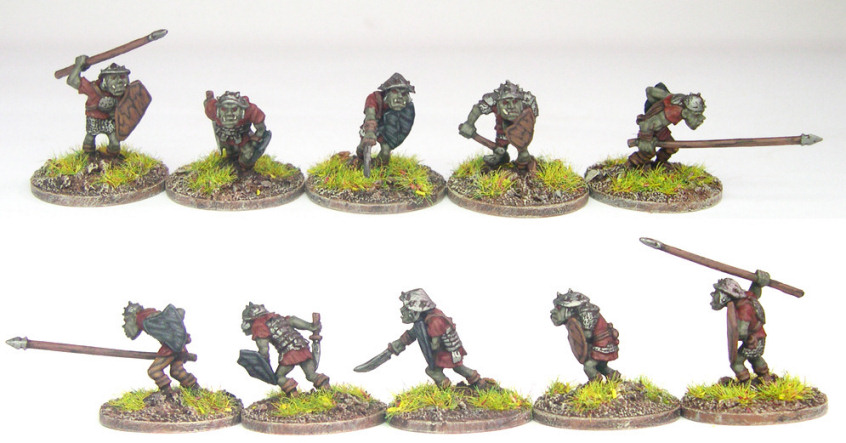
Wargames Factory recently announced the pending release of their multi-part 28mm plastic orc warrior set. This release looks awesome. Not only do Wargames Factory do an amazing job of bringing excellent plastic troops to the table for excellent value, but they have gone with the classic Angus McBride style of orcs (shown below) seen in the artwork he did for the Middle Earth RPG.


If you are a fan of this style of orc, you will know that it has inspired many orcs that have shown up throughout the history of gaming from the Mithril Miniatures line of old to the newer figures from Khurasan Miniatures in 15mm. Similar orcs also appeared in the D&D products in the later 1E and 2E days in one form or another and became the standard replacement for the old pig-face orcs during the Larry Elmore days. I really do prefer these orcs over the pig-faced or the later "extreme" orcs of 3E.

In addition to this release being perfect for adding classic, non-GW, orcy goodness to any 28mm collection but with WF's growing range of multi-pat sets (Romans, Celts, Germans, Numidians, Zulus, etc.) there are infinite possibilities for mixing and matching to create all sorts of cool conversions and combinations. One idea that came to me was to mix Human heads and arms with the orc bodies, weapons, shields to make some truly nasty looking fantasy humans. The orc heads and arms could then be used on some of the human bodies to make better equipped orcs or something like that.

I'll be picking some up, even though I don't normally play in 28mm. Heck, maybe they'll end up as some sort of beast Men of Venus or something for VSF or Pulp games.

Have fun!

-Eli


Monday, May 10, 2010

Trawling For Trolls

In my never-ending quest to add more and more projects to never be finished onto the pile of projects that have yet to be finished, I have set upon a quest for the perfect troll figures. Now, mind you that I am not in search of any ordinary troll, but a troll of a particular sort. The trolls I am looking for are not gangly and and carrot-nosed with hollow-socketed eyes nor are they the sort with floppy gremlin ear and cartoonish scaley hides. And let me not forget the other sort of trolls that I am not after - the sorts wit hthe pug-faces that come for a land rules by a cyclopic god wizard or the other tiny sort with fuzzy neon hair and wishing jewels in their gut. No, what I am looking for are trolls of a mor classic sort.

The trolls I want are those who have a look of intelligence in their smirking, leering faces. They wear clothes and carry weapons though they may be of a filthy and unfinished or downtrodden sort. The trolls I seek have hair and though their ears and noses may be big, they the sort that snuffle and ogle menacingly as they seek to devour you. They are the Mountain King and the tricksters and tormentors of simple folk and the defeaters of warriors.

Now, all poetry aside, what I am looking for are troll miniatures that are evocative of the more classic Scandinavian trolls and not GW trolls, D&D trolls or Peter Jackson Lord of the Rings trolls. The trolls I want look much more like those to be found in the old animated Hobbit and Return of the King movies or in the nicknacks of your old Norwegian grannies living room. What I also want are trolls that will look right if I set them on a table across from perfectly historical Vikings and other Dark Age sorts.

This quest has led me to a few miniatures, some new and some old. A few of them are even OOP but so nice.


OOP Julie Guthrie Troll By Grenadier - Pack #706


Two of the old Ral Partha Trolls nicely painted from the Witchhunter.net site

Thursday, April 15, 2010

Meet The Carebolds

Cursed by the gods, these few kobolds have been destined to try to fight their "better" nature and spread cheer, good will, and positivity to the world. Each of them has been gifted with a specific aspect that grants them particular powers byond those of typical kobolds. These aspect of each of the Carebolds, as they have been named, can be easily determined by the symbol emblazened upin their abdomens.

The shame these good will marks have brought these kobolds has turned them into bitter beasties, but to deny their curse is to consign themselves to an eternity with it. Only when the gods have determined that they have spread enough psotivity and good will to make up for the malice they perpetrated will the curse be lifted.

Any attempt to hide the marks on their abdomens will fail, causing clothing to burn away, armor to fall to pieces, mud to cleanse itself, etc, etc. This has made their plight even more miserable as they cannot conceal their natures nor can they really protect themselves with protection enough to keep up their usual mischief.

What is worse is that this condition seems to be contageous to other humanoids and there have been several other creatures afflicted with the curse. Orcs, bugnears, and even gnolls and hobgoblins are now counted among these "Carebold Cousins".

The following aspects of good will and positivity have been identified and provide the following spell-like abilities. All abilities are considered at 10th level where level is needed and save vs spell does apply against any of the effects. Other effects may exsist, but thse are the only ones to have been identified at this time.

Luck (clover): luck, as the spell 3 time/day. This effect is automatically granted to creatures other than the Carebolds themselves who come in contact with the creature marked with the clover symbol.

Friendship (rainbow): the creature marked with this symbol radiates the effects of a friends spell in a 30' radius.

Happiness (smiling face): this creature creates an aura of happiness and good cheer in a 30' radius. No hostile action can be taken within this radius.

Love (heart): all creatures within 30' of this creature feel a sense of love and brotherhood with one another.

Wish (star): this creature can use the wish spell once a day.

Sunshine (sun): a creature so marked radiates continual light within a 30' radius at all times.

I hope you have enjoyed this humorous bit of monster making. The drawings were simply doodles that caught on and I figured it might be fun to give them some sort of game mechanic.


Monday, April 12, 2010

[How Umber is Your Hulk?] - The Umber Hulk

Hello all,

This is the first in a short series of posts on monster variations. Monster variants are a great way to freshen up your campaign and keep your players guessing, but a lot of times monster variants are done in ways that leave them feeling like flat, plug and play monsters. I feel that variants are always best when they have as much theme and character built into them as the original monster. Often these monster variants end up becoming monsters in their own right, taking on roles greater than simply "fire breathing giant toad".

Things I tend to consider when designing variant monsters is origin of the variant. Are they sorcerous hybrids? Regional sub-species? Perhaps they are a more primitive proto-species? If a creature variant has a breath weapon then I feel I should say something about why. D&D 3.5 had a great idea with templates, but far too often these templates were used to create bland, stat-stuffed monstrosities with no greater purpose than that of a secret weapon against players and their characters. What I am proposing is a bit more individual and creative than simple templating.

As my first example, I will offer the umber hulk, stated up here for Labyrinth Lord (because it's not already in there!) and then two variants I have come up for the creature. It should be noted that these variant hulks go back to my D&D 2nd ed and 3.5 days.

Umber Hulk
No. Encountered: 1-4
Alignment: Chaotic
Move: 60' (20'), 10'-60' burrowing
Armor Class: 2
Hit Dice: 8+8
No. of Attacks: 3
Damage/Attack: 3-12/3-12/2-10
Save: F8
Morale: 10
Horde Class: V
XP: 1200

Umber hulks are subterranean predators. Their iron-like claws enable them to burrow through solid stone at 1" per turn and through loam at fully 6 times that rate. Their prey includes young purple worms, anhkheg, and similar monsters. However, the favorite prey of umber hulks are humans. They attack with claws and their powerful mandibles. Worse still, any intelligent creature which views the umber hulk's four eyes squarely must save versus magic or be confused for 3-12 melee rounds. These creatures have their own language.

Umber hulks are black, shading to yellowish gray on the front. Their head is gray on top, and the mandibles are ivory colored. Because of their dark color they can easily be mistaken for some humanoid creature at 40' or more distance.

Scarab Hulk
No. Encountered: 1-4
Alignment: Chaotic
Move: 60' (20'), 10'-60' burrowing
Armor Class: 2
Hit Dice: 8+8
No. of Attacks: 3
Damage/Attack: 3-12/3-12/2-10
Save: F8
Morale: 10
Horde Class: VI
XP: 1500

Scarab hulks are specially bred umber hulks that are used as guardians of tombs and catacombs. Raised on a diet of corpses and carrion, they become accustomed to death. When still young they are sealed inside tombs where they serve as guardians.

In addition to the normal abilities of regular umber hulks, scarab hulks carry deathly diseases and tomb rot that they pass onto their victims. If wounded by a scarab hulk a victim must save vs poison or contract a deadly rotting disease that inflicts 1d3 hp of damage per day.

Scarab hulks differ in appearance from the common variety in that they are almost completely black in color with irridescent carapaces that reflect light like oil. They are oftenfound with bits and pieces of tomb treasure or even ceremonial wrappings draped about their bodies.

Tremor Hulk
No. Encountered: 1-2
Alignment: Chaotic
Move: 60' (20')
Armor Class: 2
Hit Dice: 10
No. of Attacks: 3
Damage/Attack: 3-12/3-12/2-10
Save: F10
Morale: 10
Horde Class: None
XP: 1350

Tremor hulks are a rare, surface-dwelling cousin to the more common umber hulk. Larger in size they possess the ability to pound their massive claws against the ground, creating localized tremors that radiate around them, causing destruction. A tremor hulk can spend an entire round not attacking and instead pound its claws into the ground, creating a quake. Those within 50' of the hulk must save vs. paralysis or be thrown to the ground. The hulk can maintain the quake for up to three rounds. Tremor hulks do not possess the confusing powers of common umber hulks

Tremor Hulks have very subdued coloration, appearing quite stoney and earthen. Colors range from greys to browns with speckling and mottling common along the claws and main body.


Related Posts Plugin for WordPress, Blogger...